Thrill

Verdict: Four Stars
A “Beauty and the Beast” retelling set in the mid-18th century, where the beast is a scarred Scottish werewolf laird and the beauty is a resilient English debutante. High adventure meets romance.
Premise
Set in a softly focused, non-strictly historical 18th-century England and Scotland, Kieran, Laird of the Barclay clan, seeks to marry a high-born Englishwoman to legitimize his standing and shield his lands from English raids. Julia is forced to step in to save her younger sister from an arranged marriage to a complete stranger, imposed by their spendthrift half-brother. Through a series of gripping and well-paced adventures, Julia displays immense strength of character and a profound acceptance of the “beast,” eventually winning the heart of the scarred and irresistible laird.
Ideal Reader and Market Fit
The novel’s greatest strength lies in its atmospheric setting, which strikes a compelling balance between Maggie Stiefvater’s Shiver and Washington Irving’s The Legend of Sleepy Hollow. It features a fiercely determined heroine alongside a strong cast of resilient female characters. The core appeal rests not on slow-burn romantic tension or pure Gothic mystery, but rather on the thrilling, fast-paced momentum of the adventure itself.
The authors effectively tap into the escapist demands of a broad audience, standing out for their highly immersive locations and dynamic action sequences. The narrative includes explicit romance scenes, making it a strong fit for mature audiences within the historical fantasy romance market.
Craft
Action and combat sequences completely steal the show. Grieco and Grazzini excel at sketching logistical setups and physical confrontations with a few sharp, vivid brushstrokes. The prose is fluid, highly accessible, and skillfully employs popular narrative tropes designed for a mainstream, entertainment-seeking readership.
Considerations for Translation
The novel presents a specific structural challenge regarding its romantic development, as the dialogue is rarely used to map the emotional evolution of the leads. It lacks the witty, subtext-heavy verbal sparring typical of the British Period Romance tradition—that essential “Shaftesburyan” conversation where the hero and heroine negotiate their conflicting worldviews to organically forge a bond. Instead, the emotional mood shifts somewhat abruptly.
At a Glance
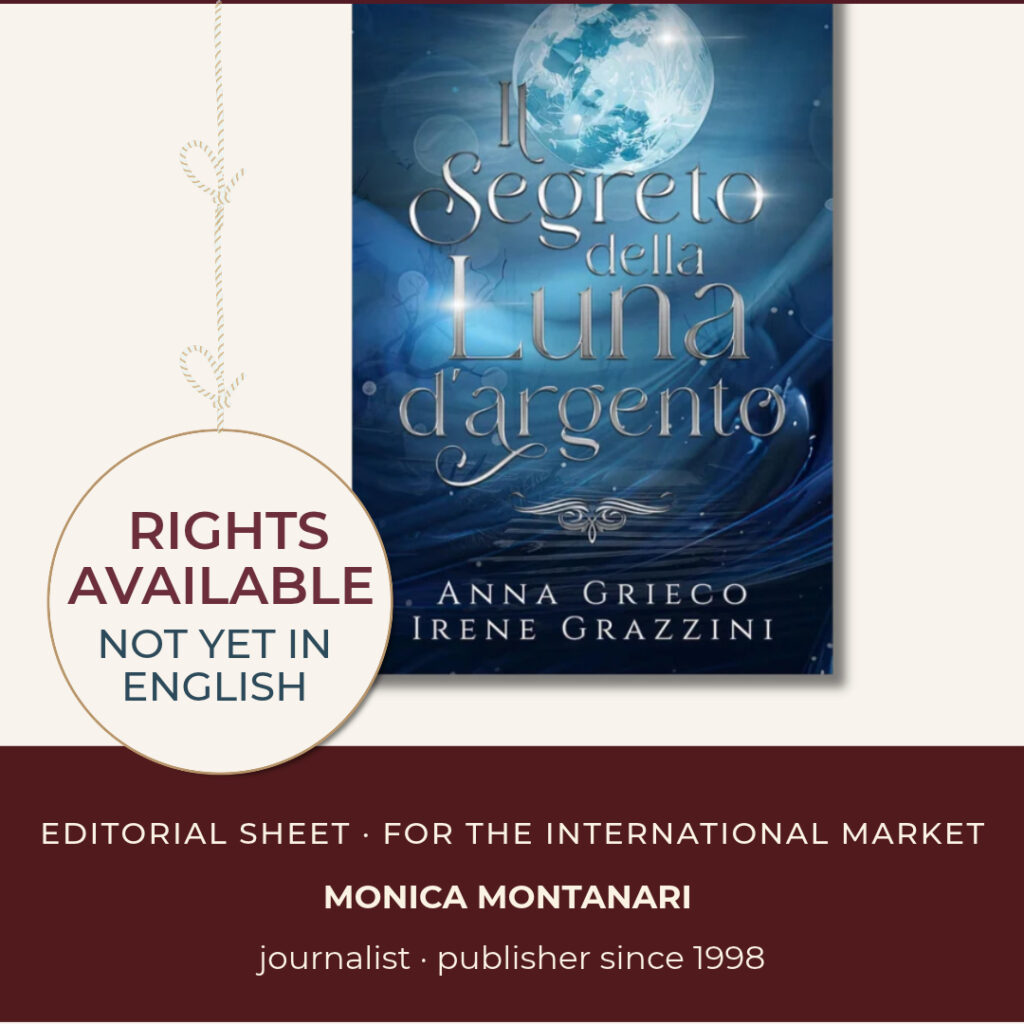
- Author: Anna Grieco & Irene Grazzini
- Original Title: Il segreto della Luna D’Argento
- Genre: Historical Fantasy Romance / Adventure
- Length: 383 pp.
- Original Language: Italian
- Rights: Available – Not yet in English
- Format: Standalone
The authors are highly prolific and have previously been published by major houses such as HarperCollins Italy and Mondadori. The concrete, straightforward nature of the prose poses no significant technical difficulties for translation.
Closing Assessment
This novel is well-suited for publishers looking for commercial historical romance with strong fantasy elements and high-stakes adventure. It represents a solid market opportunity for international editors focusing on fast-paced, high-escapism genre fiction.
Editorial sheets for the international market
Monica Montanari is a professional journalist (Italian Order of Journalists).
An independent publisher for 30 years and the author of 30+ books.
Raw reading impressions
What we have here is a bit of “Scottish magic” in the vein of Diana Gabaldon’s Outlander. It’s the kind of fantasy that acts as a mere light brushstroke, never quite crossing over into true Gothic territory. However, it succeeds brilliantly as a gripping adventure novel—I devoured it in two days, reading late into the night. As for the historical accuracy and setting, you just have to turn a blind eye to the sheer improbability of anyone enjoying a “warm, balmy dip” in the North Sea during autumn!
But Grieco and Grazzini aren’t the only culprits. I just finished a historical romance by Jenni Fletcher where the heroine goes swimming in Whitby—an area looking straight out toward Denmark—in the dead of October! Literally. The book claims she grew up in Scotland, so hey, maybe she knows something I don’t. Those Nordics must have skin like iron. Personally, I’ll believe it when I see it. Google tells me people do swim there, sure, but wrapped head-to-toe in heavy neoprene wetsuits.
Fair enough, freezing sea temperatures aren’t a dealbreaker for suspending one’s disbelief. The real issue—and a much more fatal flaw for a romance—is that Grazzini and Grieco fail to capture the true Georgian romantic mood. Their dialogues are mere exchanges of information, completely lacking the art of conversation in the classic British sense.
The characters are too one-dimensional, their motivations too flat to weave the intricate, witty arabesques of a proper Shaftesburyan dialogue. If the rugged Laird’s entire personality boils down to what you’d expect from a stereotypical clan chief—namely, a desperate urge to give orders—what on earth is he supposed to talk about with his lady, other than: “Pantaloon off, milady!”?
And when she, acting the part of the proud English noblewoman, snaps back: “Never!”, the Laird is left with only two choices: strip them off himself or storm out slamming the door. Either way, the conversation is officially dead.
Impressioni di lettura nude e crude
Abbiamo qui uno «Scottish magic» tipo La straniera di Diana Gabaldon. Cioè quel fantasy che in realtà è appena una pennellata e che non riesce a diventare gotico. Riesce invece benissimo a diventare un avvincente romanzo d’avventura – l’ho letto in due giorni e facendo tardi la notte. Quanto all’ambientazione e al contesto storico bisogna non far troppo caso alla credibilità di bagni tiepidi nel Mare del Nord in autunno!
Ma Grieco e Grazzini non sono le sole: ho appena letto un romanzo di Jenni Fletcher dove l’eroina fa il bagno a Whitby (dalle cui coste si vede la Danimarca) in ottobre! Sic. Dice che è cresciuta in Scozia. Lo saprà! Incredibile pellaccia questi nordici! Comunque, se io non lo vedo, non ci credo. E Google dice che lo fanno, il bagno, ma con le tute in neoprene.
Va bene, la temperatura del mare del Nord non rappresenta un vero ostacolo ad abbandonare l’incredulità. Il limite più serio, per un romance, è che Grazzini e Grieco falliscono nel condurci nel mood sentimentale georgiano. Perché i loro dialoghi sono comunicazioni, non conversazioni nel senso britannico del termine.
I personaggi monodimensionali non sono articolati a sufficienza negli intenti per poter tessere gli arabeschi della conversazione shaftesburiana. Se il laird di turno esprime come personalità solamente ciò che è lecito attendersi da un capo clan, ovvero il desiderio di comandare… di cosa lo fai parlare con la sua bella, se non: «Signorina, toglietevi le mutande!»?
E quando lei, da orgogliosa nobildonna inglese, gli risponderà: «Non sia mai!», al laird non resterà che provvedere di persona o andarsene sbattendo la porta. In ogni caso la conversazione è finita.