Heartbeat
Lyanne Quay
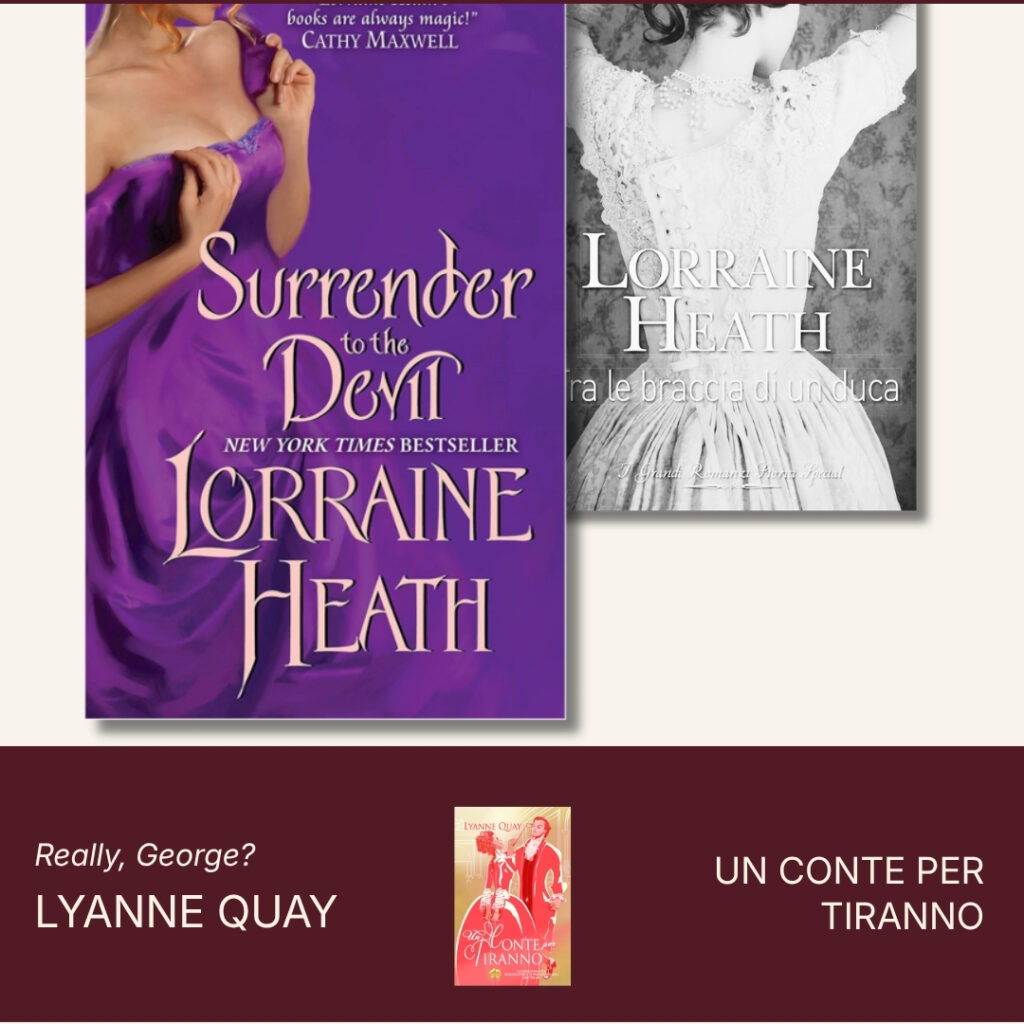
You need Heath’s damaged hero to cry in Surrender to the Devil. Here we are. Sooner or later I shall have to give in.
So: beautifully written, an opening that howls — but but but. I do not like tears, and this one wrung a couple from me at the end.

I understand the Dickensian surge. I do not share the choice to have a twelve-year-old girl raped in order to build a fine love story. I do not share the need to lame the stallion somehow so the mare can reach him, mutatis mutandis.
I will not spoil the book by floating facts the reader does not get from chapter one. Still, there seems to be a line of thought among the writers — and perhaps, who knows, among the readers — that the two leads must be a match: damaged she and damaged he, or both of them stunning.
A historical romance with a happy ending that is not a fairy tale
I do not belong to that line of thought. Why, damn it, write romance planted even deeper in the unreality of a picture-postcard past, if not to be spun by what first looks impossible: that a perfect girl falls for an imperfect man, and a perfect man falls for an imperfect girl?
And yet it happens in life. Camilla preferred to Diana. The well-seasoned woman who holds baby Macron’s heart. How many times have we asked: how can she be with him? How can he be with her? If you don’t believe it, why the hell write romance at all?
A tear-jerker historical romance
A tear-jerker historical romance. By pure chance I read three books in a row built on a damaged hero: 1) Heath’s first Pembrook, 2) the first of Reid’s Sinful Wallflowers, and 3) this Surrender to the Devil, Heath again.
In the first we get a slightly cape-and-sword feuilleton where Heath cannot handle the sentimental turn at the end. In this one, she is perfectly perfect and he is imperfect.
In the second, Reid’s, we get a retelling of Beauty and the Beast, extraordinarily bright even if the ending is thick with pain. That pain, full of love, works because it breaks into a trusting view of life: underneath, both are perfect (inwardly), because suffering does not cancel happiness.
Then we have this clasping duke, where both have gone rotten inside from suffering, and that throws a dark shadow over the close. However they find each other, they are two broken souls, and that wrings the tear out of me.
On top of that, this novel has a fault in how it draws the heroine: she does not read or interpret the man except in one dimension, physical pull.
What to say? Well made. A perfect piece of craft. I give it five stars. I would not recommend it. It is a slab of pudding.
Ci vuole l’eroe lesionato di Heath per piangere Tra le Braccia di un Duca. Eccoci. Prima o poi dovrò rassegnarmi.
Dunque: benissimo scritto, incipit da urlo, ma ma ma… A me le lacrime non piacciono e questo me ne ha strappate un paio sul finale.
Capisco l’afflato dickensiano, ma far violentare una bambina di dodici anni per mettere su una bella storia d’amore non lo condivido e nemmeno condivido la necessità di azzoppare lo stallone in qualche modo per renderlo raggiungibile dalla giumenta: mutatis mutandis.
Non voglio rovinare la lettura anticipando elementi che non vengono presentati al lettore fin dal primo capitolo, ma sembra che vi sia una linea di pensiero tra le narratrici, e probabilmente — chissà? — tra le lettrici, per cui in qualche modo i due protagonisti devono essere pari: sfigata lei sfigato lui, o entrambi fighissimi.
Un historical romance con happy ending ma non favolistico
Non appartengo a questa linea di pensiero. Perché, accidenti, scrivere romance tanto più piantati nell’irrealtà di un periodo storico cartolinesco, se non per farsi affabulare da ciò che a tutta prima parrebbe impossibile, e cioè che una ragazza perfetta si innamori di un imperfetto e, viceversa, un perfetto si innamori di una ragazza imperfetta?
Eppure, se ci pensiamo, accade anche nella realtà: Camilla preferita a Diana, o la superstagionata che incatena il cuore di baby Macron… Quante volte nella vita ci siamo chieste: ma come fa quella a stare con quello? Come fa quello a stare con quella? Se non ci credi, che cazzo li scrivi a fare i romance?
Romanzo rosa storico strappalacrime
Il fatto è che per un caso assoluto mi sono letta tre libri in batteria fondati su un eroe lesionato: 1) il primo Pembrook della Heath, 2) il primo delle Sinful Wallflowers della Reid e 3) questo Tra le braccia di un duca, sempre della Heath.
Nel primo abbiamo un feuilleton un po’ cappa e spada dove la Heath non sa gestire l’evoluzione sentimentale del finale. In questo romanzo invece lei è perfettissima e lui imperfetto.
Nel secondo, quello della Reid, abbiamo un retelling de La bella e la bestia, straordinariamente brillante anche se denso di dolore nel finale; quel dolore pregno d’amore funziona proprio perché esplode in una visione fiduciosa della vita in cui, al fondo, entrambi sono perfetti (interiormente), perché la sofferenza non mina la felicità…
E poi abbiamo questo duca abbracciante dove entrambi sono marciti dentro per via della sofferenza e ciò allunga un’ombra cupa sullo scioglimento. Per quanto si trovino, sono due anime spezzate e questo mi strappa la lacrima.
In più, in questo romanzo, abbiamo un difetto di rappresentazione dell’eroina, che non analizza e interpreta il coprotagonista se non unidimensionalmente, in termini di attrazione fisica.
Cosa dire? Ben fatto, prodotto artigianale perfetto, metto cinque stelle, ma non lo consiglierei. Trattasi di polpettone.