Thrill
Lyanne Quay
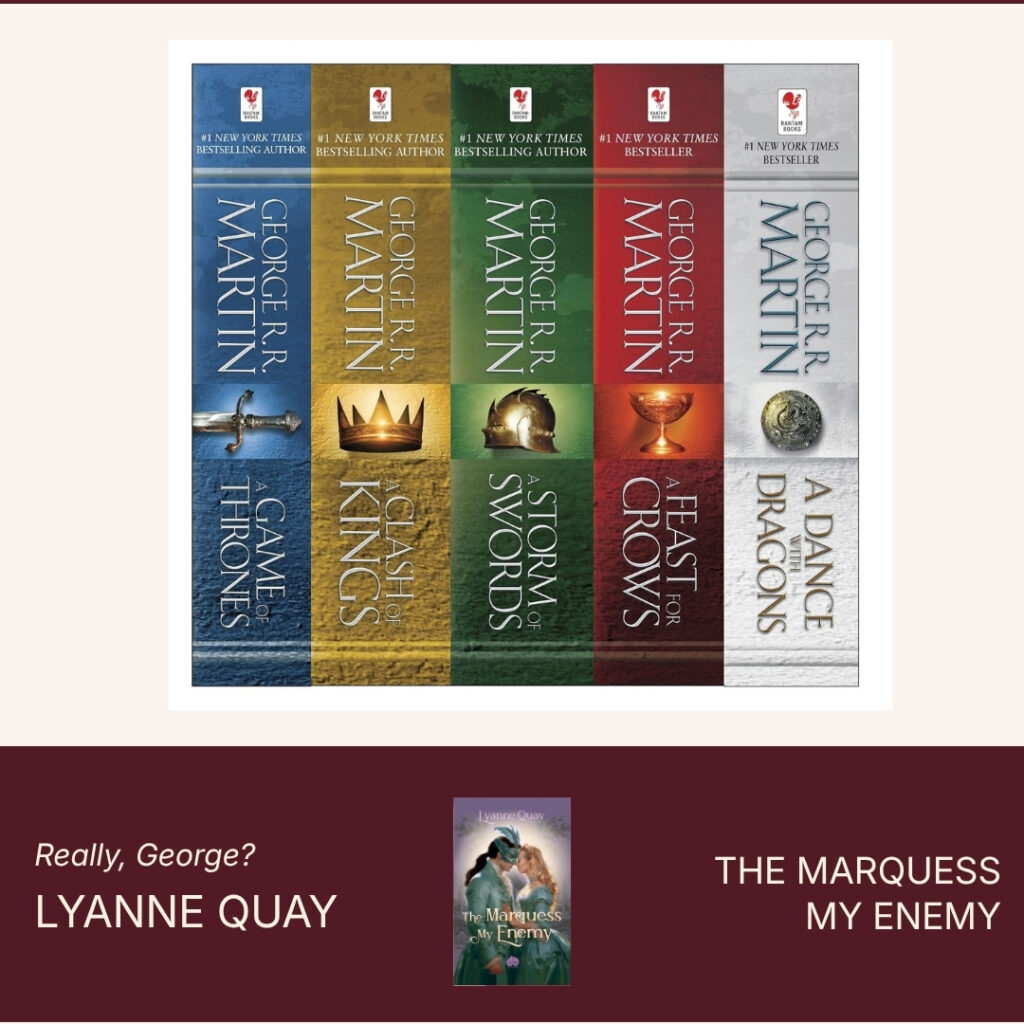
…And by A Song of Ice and Fire I mean every volume. So I will talk about A Game of Thrones, A Clash of Kings, A Storm of Swords, A Feast for Crows and A Dance with Dragons, in their messy correspondence with the translations published in all sorts of countries.
Well, I’ll admit it: I have put this review off for far too long. Fantasy does this to me. It leaves me estranged and short of words. And the fantasy of the Chronicles is a real psychedelic journey. It goes beyond building a world that does not exist and it does not stop at imagining… ‘supernatural things’, I was about to write.
I won’t write that. I stop here for the first note.

What happens in the world of A Song of Ice and Fire is never ‘supernatural’
The most extraordinary events – even brooding over dragon eggs and hatching them – are natural, because that is how the characters live them.
Dignitaries flock to the Free Cities to see Daenerys’s creatures, but they are never stunned or appalled. If anything they look pleased, admiring, in front of the magic.
Not even the Maesters of the Citadel, those sceptics, are astonished by the wonders. In a reality that conforms, in Schopenhauer’s sense, to the will, they simply do not see them. They wave magical things away as Old Nan’s stories or legends of the First Men. Far from the stable castle life run by the maester of the hour, though, wild nature takes hold, and with it its ‘more than natural’ mysteries.
George Martin takes us out of Cartesian logic and he pulls it off, showing the limit of that logic in the time-horizon of the scientific experiment.
Take a statement: ‘Man cannot fly without aids made by human ingenuity’.
In Martin’s world that is true only in Maester Luwin’s eyes. Widen the look to the forests and those who live there, to the millennia of their history, and you see that nature did give creatures wings and let them fly with no human kit at all.
Someone will say: ‘Well, obviously!’ The miracle looks less like the power of nature than the power of time: the millions of years species need to evolve. And that is where I wanted you.
Because in Martin’s world, time does not exist
I have worked out that the Chronicles as they stand equal about 25 average novels.
While we have grown old reading them and he has grown old writing them, the people in the Song are frozen in a world without time. Mostly they get killed. Ageing and dying of age barely come up. Old Nan fades into the eternal. Only the hundred-year-old Aemon Targaryen will finally kick the bucket of old age.
In the Song, time does not run and does not count. Proof: they marry and they fight at an age when our children still struggle with their shoelaces.
The estranging, enchanting effect of the work owes a great deal to this illustrious absentee, told to stay out of the genetic code of Martin’s whole invention.
The world of A Song of Ice and Fire is born from the logic of ‘play’. The map of the Seven Kingdoms goes down on the table like a Monopoly board, tokens forever the same.
Characters, maps and tokens have to stay as they are, immune to becoming, so we can play, imagine, interpret and care, without end.
Five stars.
…E per A Song of Ice and Fire intendo proprio tutti i volumi. Parlerò dunque di A Game of Thrones, del Clash of Kings, della Storm of Swords, di Feast for Crows e di Dance with Dragons, nella rispettiva e confusa corrispondenza con le varie traduzioni pubblicate nei Paesi più diversi.
Beh, lo ammetto: ho rimandato questa recensione per troppo tempo. Il fantasy mi fa così, mi lascia straniata e a corto di parole. E il fantasy delle Cronache è davvero un grande viaggio psichedelico. Va oltre il semplice edificio di un mondo inesistente e non si limita a immaginare… «cose soprannaturali» stavo per scrivere.
Non lo scrivo però e mi fermo per fare la prima notazione.
Ciò che accade nel mondo della Song of Ice and Fire non è mai «sovrannaturale»
Gli eventi più straordinari – persino covare amorevolmente uova di drago e farle schiudere – sono naturali perché come tali sono vissuti dai personaggi.
I dignitari accorrono nelle Città Libere a vedere le creature di Daenerys, ma non restano mai stupiti o allibiti; semmai si mostrano compiaciuti e ammirati dinanzi alla magia.
Nemmeno i maestri della Cittadella, tanto scettici, si stupiscono dinanzi ai prodigi. In una realtà che si conforma schopenhauerianamente alla volontà, semplicemente non li vedono. Liquidano le cose magiche come storie della vecchia Nan o leggende dei Primi Uomini. Lontano però dalla stabilità della vita di castello dominata dal maestro di turno, prende piede la natura selvaggia e con essa i suoi misteri «più che naturali».
George Martin ci porta fuori dalla logica cartesiana e ce la fa, svelandone il limite nell’orizzonte temporale dell’esperimento scientifico.
Si consideri un’affermazione: «l’uomo non può volare senza ausili fabbricati dall’ingegno umano».
Nel mondo di Martin ciò è vero solo agli occhi di Mastro Luwin. Se infatti si allarga lo sguardo alle foreste e ai suoi abitatori, ai millenni della loro storia, si vede come in realtà la natura abbia provvisto ali alle creature e consentito a esse di volare senza ausili d’ingegno umano.
Mi si dirà: «bella forza!». A produrre il miracolo non sembra essere la potenza della natura ma quella del tempo, i milioni di anni necessari all’evoluzione delle specie. E qui vi volevo.
Perché nel mondo di Martin il tempo non c’è
Ho calcolato che l’estensione attuale delle Cronache equivale a 25 romanzi medi.
Mentre noi a leggerle e lui a scriverle ci siamo fatti vecchi, i protagonisti della Song sono cristallizzati in un mondo senza tempo dove per lo più si viene uccisi, ma invecchiare e morire non se ne parla. La vecchia Nan sfuma nell’eterno e solo il centenario Aemon Targaryen alla fine tirerà le cuoia per raggiunti limiti d’età.
Nella Song il tempo non scorre e non conta, lo dimostra per esempio il fatto che ci si sposi e si combatta a un’età in cui i nostri figli ancora faticano ad allacciarsi le scarpe.
L’effetto straniante e incantatore dell’opera è grandemente debitore a questo illustre assente chiamato a latitare dal codice genetico di tutta l’invenzione di Martin.
Il mondo della Song of Ice and Fire nasce infatti con le logiche del «gioco». La mappa dei Sette Regni si stende sul tavolo come il cartone del Monopoli, con i suoi segnaposti eternamente uguali a se stessi.
Tali dovranno rimanere personaggi, mappe e segnaposti, immuni al divenire per permetterci di giocare, immaginare, interpretare e appassionarci, all’infinito.
5 Stelle.