Heartbeat
Lyanne Quay
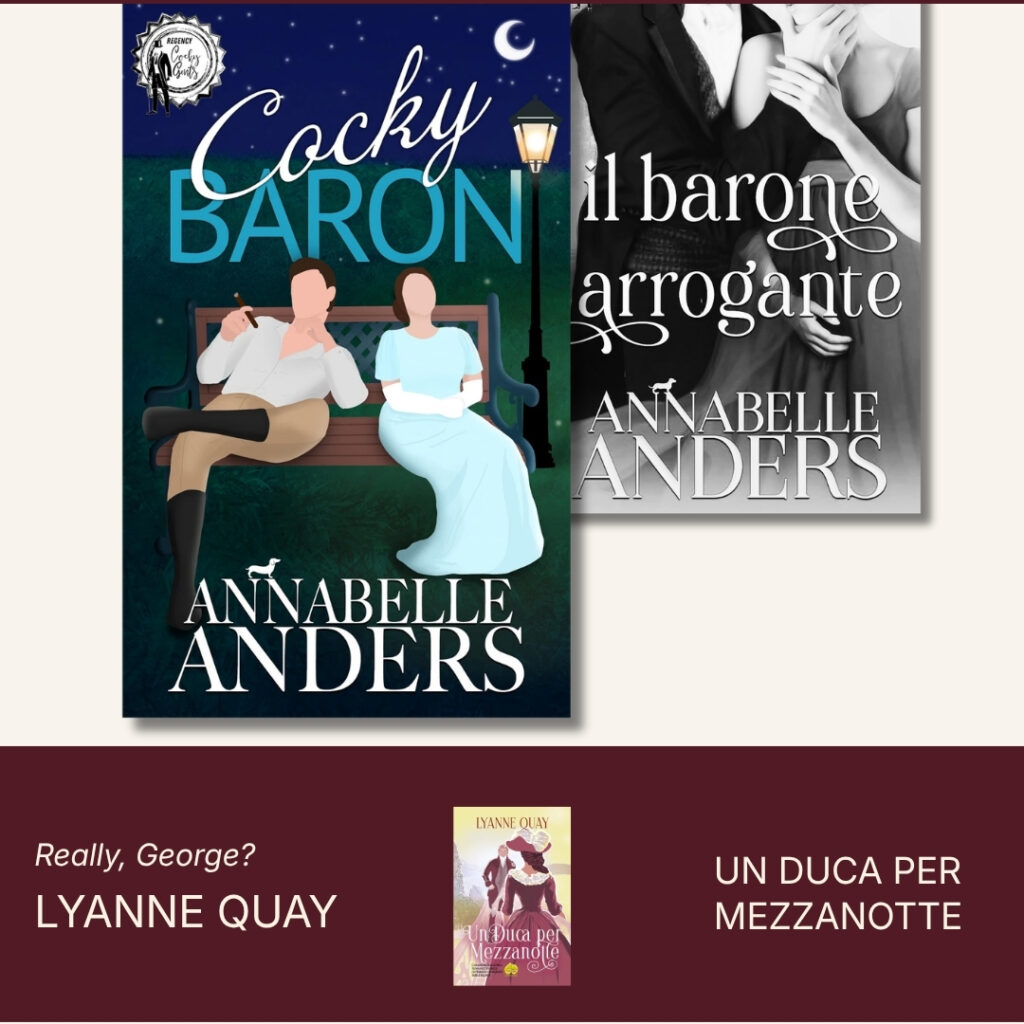
Great Italian translation and a hugely satisfying novel: the baron may be cocky, but Annabelle Anders’ Cocky Baron is brilliant.
Let’s celebrate: Balogh, Grace, Cornick, Dunmore, Reid, Gracie and MacLean now have another first-rate author to join them: Annabelle Anders. According to her bio, if I understood the English right, she has published forty Regencies in seven years… Sounds unlikely to me. Dunno. Either she wrote them over a lifetime and they were manuscripts in a drawer, or Annabelle Anders is a pen name hiding several authors. Point is, this cocky baron isn’t cocky at all, except for being bound to fit the cycle of cocky lords of assorted ranks.

A brother’s best friend historical romance
A brother’s best friend historical romance. The basic frame is a bit predictable, but there are some very inventive touches. It’s the usual “spinster” who’s always been in love with her brother’s friend, a rake. And here we are at the eternal question: why did the jerk never notice her? The answers romance authors come up with, Italian ones especially, veer invariably into masochism, with the hero of the day slow to outgrow his inner brute.
A Regency with a touch of melancholy and great faith in love
A Regency with a touch of melancholy and great faith in love. Here, though a vein of melancholy hums in the background, thankfully it’s not that. The mopey side at the start comes from the heroine. Soon after her debut, because of something that comes out in the finale, her heart withered. She began to fend off anxiety with obsessive habits like counting the letters in words, and to show it by pursing her lips into a thin line that gives her a stern, disapproving look, the look of a woman left out.
He, on the other hand, for reasons that come out along the way, was simply distracted by problems far more serious than flirty skirmishes, and also put off by that very manner of hers. What adds melancholy to the novel is her lingering doubt that she can be loved, and her passive submission to the brutally scornful words of her family circle, who take it for granted he can’t really love her. With Anders we get Balogh’s depth, but in razor-sharp focus.
A period romance that pulls you in, full of word gems
A period romance that pulls you in, full of word gems. An Italian blogger friend of mine faults Balogh for blurry writing. Well, here we get both virtues: great psychological depth in the characters and razor-sharp definition of the scene. Of course, all this takes room. This novel gives you the joy of a read that isn’t frantic, where you can sink into the myths and rites of the Historical genre, enjoying the clear-headedness of the characters and the total absence of the rhetoric of pain.
It should be read by every historical romance author, if only for the background knowledge: from country dances, to Sir Roger de Coverley, to shopping on Bond Street. The Italian edition is very well translated. But the reasons to admire the author don’t stop there. The novel takes on the real sacred monster of every historical romance author: having the newlyweds live in London.
How do you get love off the ground in a marriage of convenience, or one meant to repair a reputation, if the couple is expected not to see each other during the day and to stay well apart at parties? How can the rake of the day realize he loves our heroine if, the day after the wedding, he goes back to his usual life? Well, instead of bypassing the problem with a trick, Anders shows us exactly how the hero gradually pulls away from his old life. She lets us watch it up close.
A historical romance with a high-concept, far-from-predictable plot
A historical romance with a high-concept, far-from-predictable plot. And finally, the inventiveness. There are a couple of very funny touches. In the cocky circle there’s a duke who lost a bet and for several weeks has to serve as butler at his friend the viscount’s house. And then there’s the device specific to this novel: the compromising scene that forces hero and heroine to marry.
It’s not the usual little kiss, or the usual lowered corset. We’re in a folly, in a private park, during a reception. The hero, convinced his mistress has caught up with him, grabs the heroine, pulls her onto his knees, flips up her skirts, uncovers her milk-white little bottom and starts spanking her soundly, thinking that’s how to please his mistress, of course… Our hero doesn’t get why she’s thrashing around so much, and keeps going… So when a big group of guests shows up, the heart-shaped behind of our heroine is left on display for the wonder, and later the scandalized comments, of London high society 🙂🙂
Forgot to say: explicit and very awkward sex scenes.
Gran traduttore e romanzo di grande soddisfazione, il barone sarà arrogante ma la Anders è bravissima.
Festeggiamo: a Balogh, Gracie, McCornick, Dunmore, Reis e MacLean si aggiunge un’altra autrice coi fiocchi: Annabelle Anders. Secondo la biografia – se non ho capito male l’inglese – avrebbe pubblicato quaranta Regency in sette anni… Mi par poco credibile. Boh, o li ha scritti nell’arco della vita ed erano manoscritti nel cassetto o questo nome Annabelle Anders è un nome editoriale dietro cui si nascondono più autrici. Resta il fatto che questo barone arrogante non è arrogante affatto, se non per il vincolo di dover rientrare nel ciclo degli arroganti in vari gradi di nobiltà.
Un historical romance migliore amico del fratello
Un historical romance migliore amico del fratello. Questo romanzo ha uno schema di base un po’ scontato ma presenta spunti di grande inventiva. Si tratta della solita «zitella» innamorata da sempre di un amico del fratello, nonché libertino. E qua siamo all’eterno quesito sul perché lo stronzo non si sia mai accorto di lei. Le soluzioni offerte dalle autrici romance, soprattutto italiane, in questo caso virano invariabilmente sul masochismo e il lui di turno in questi casi tarda a emanciparsi dalla propria anima bruta.
Un Regency con un pizzico di malinconia e grande fiducia nell’amore
Un Regency con un pizzico di malinconia e grande fiducia nell’amore. In questo caso, pur restando in sottofondo una vena di malinconia, fortunatamente non è così. L’aspetto tristanzuolo iniziale è dato dalla protagonista. Lei, poco dopo il debutto – per un fatto che emergerà nel finale –, è appassita nel cuore, ha cominciato a sventare l’ansia con processi ossessivi come contare le lettere delle parole, a manifestarla contraendo le labbra in una riga sottile che le conferisce un’espressione severa, disapprovante, da donna esclusa.
D’altro canto lui, per fatti che emergono via via, era semplicemente distratto da problemi ben più seri che non le schermaglie galanti, oltre che allontanato dal suddetto modo di fare della giovane. A conferire malinconia al romanzo è inoltre la perdurante sfiducia di lei sulla possibilità di essere amata e la sua soggezione inerte alle parole brutalmente sprezzanti dell’entourage familiare, volte a dare per scontato che lui non possa realmente amarla. Con la Anders abbiamo la profondità della Balogh, ma una messa a fuoco nitidissima.
Un period romance con effetto immersivo e ricco di chicche lessicali
Un period romance con effetto immersivo e ricco di chicche lessicali. Una blogger italiana mia amica rimprovera alla Balogh una scrittura sfocata. Bene, in questo caso abbiamo entrambi i pregi: una grande profondità psicologica dei personaggi e una definizione nitidissima della scena. Ovviamente tutto ciò prende spazio. Questo romanzo offre la gioia di una lettura non convulsa, dove poter sprofondare in miti e riti del genere historical, godendo della lucidità dei personaggi e della totale assenza di retorica del dolore.
Andrebbe letto da tutte le autrici di romance storici, anche solo per le conoscenze di contesto: dalle country dance, alla Roger de Coverley, agli acquisti per compere in Bond Street, al «banditore» – finalmente ha un nome! – ovvero il tizio che annuncia il nome degli invitati all’ingresso di un ricevimento. Nei balli pubblici delle Assembly Rooms è il «cerimoniere» ma non sapevo come si chiamasse nei grandi ricevimenti privati. Bene, si chiama banditore, evviva.
Il libro, molto ben tradotto, ci offre inoltre la parola «capriccio» per identificare ciò che altrove viene chiamato «follia» dal francese, per indicare le strutture architettoniche di puro fine decorativo sparse nei parchi dell’epoca, pubblici e privati. Ma i motivi di ammirazione per l’autrice non finiscono qui. Il romanzo affronta il vero mostro sacro di ogni autrice di historical romance: far risiedere i neosposi a Londra.
Come far decollare l’amore in un matrimonio di convenienza o riparatore se ci si aspetta che gli sposi durante il giorno non si frequentino e ai ricevimenti restino ben distanti? Come può il libertino di turno accorgersi di amare la nostra lei, se all’indomani del matrimonio ricomincia con la sua solita vita? Ecco, la Anders, invece di bypassare il problema con un artificio, ci mostra esattamente come gradualmente l’eroe si distacca dalla sua vecchia vita. Ce lo fa vedere da vicino.
Un romance storico dalla trama non scontata
Un romance storico dalla trama non scontata. E infine l’inventiva: ci sono un paio di spunti molto divertenti: nel giro degli arroganti c’è un duca che ha perso una scommessa e per svariate settimane è costretto a svolgere le funzioni di maggiordomo a casa del visconte suo amico. E poi il dispositivo specifico di questo romanzo: la scena compromettente per cui l’eroe e l’eroina sono costretti a sposarsi.
Non si tratta del solito bacetto, o del solito corsetto abbassato: siamo dinanzi a un capriccio, in un parco privato durante un ricevimento, lui, l’eroe, convinto di essere stato raggiunto dalla propria amante, afferra l’eroina, se la tira sulle ginocchia, le scoperchia le sottane, scopre il sederotto latteo e si mette a sculacciarla di santa ragione credendo di compiacere così le preferenze dell’amante, appunto… Il nostro eroe non capisce perché lei si dimeni tanto e continua… Così, al sopraggiungere di un gruppo nutrito di invitati, la forma a cuore del deretano dell’eroina resta esposta alla meraviglia e successivamente ai commenti scandalizzati del bel mondo londinese 🙂🙂
Dimenticavo: scene di sesso spinte e molto imbarazzanti.