Brio
Kyanne Quay
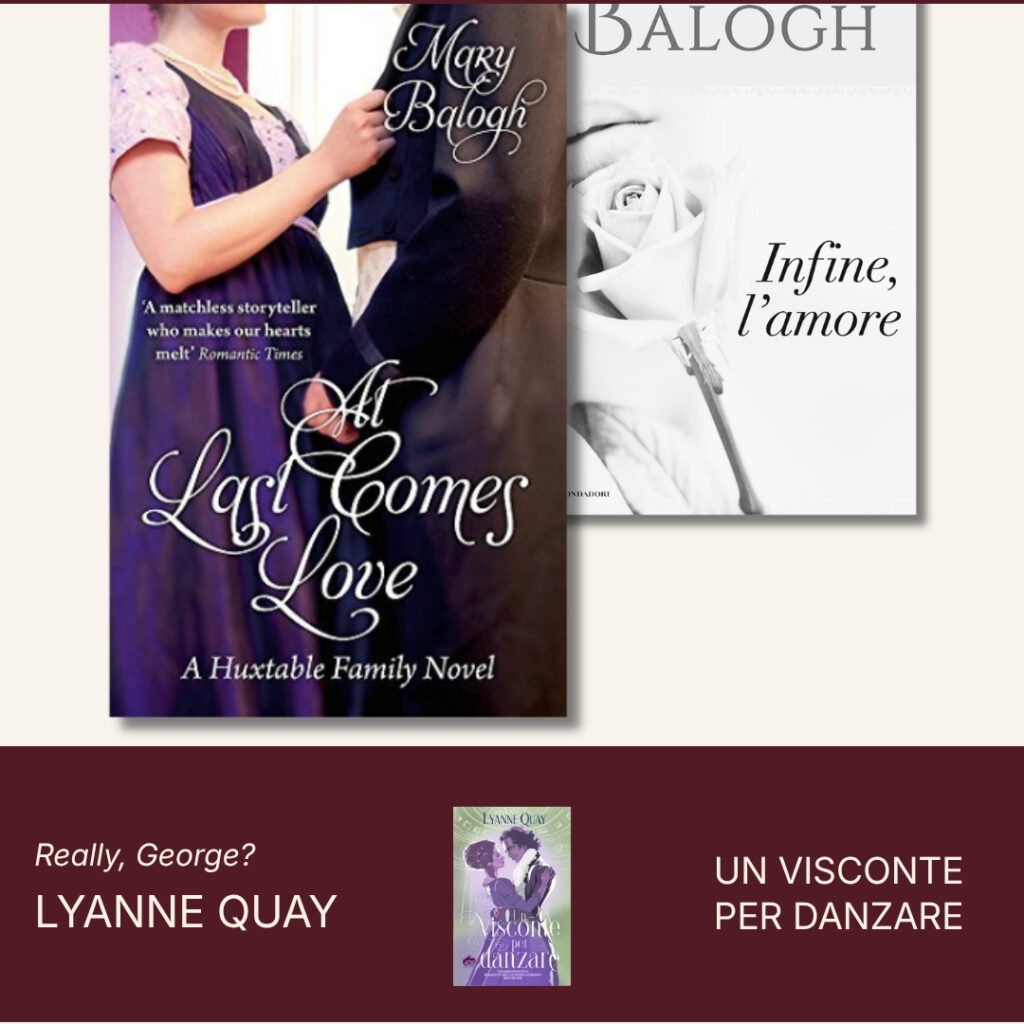
A love fairy tale in fabulous prose: with Balogh’s At Last Comes Love, happiness comes at last.
This book bewitched me right away. It’s Balogh’s most adult novel, a Regency where the heroine is basically a modern woman with no doubts at all. The hero brings the sensuality of intelligence. And the novel’s thesis is a real challenge: magic, falling in love, is a decision. You learn to love. Finally, there are passages I’ll quote where Mary Balogh talks about us, her readers, and asks herself about the very foundations of romanticism in women.

A historical romance with unforgettable characters
A historical romance with unforgettable characters. Let’s take it in order. The hero, Duncan, wants to give little Toby a home, and he can’t accept being temporarily shut out of his own estate, which he’ll inherit anyway when his grandfather dies. To avoid waiting years and years to take possession, he has only one way: he has to marry within 15 days, and someone presentable.
Meg, meanwhile, has decided to accept a marriage proposal from an old friend just to get rid of the repentant man who seduced and abandoned her years ago… Unfortunately, she finds out the old friend has gotten engaged, and her plans go up in smoke.
Well, Duncan walks into the ballroom looking for a wife, Meg is walking out of it, despairing of ever finding a husband… And they collide 🙂 Instead of apologizing, he goes straight to the point:
“Please excuse me,” (Meg) repeated, when the grip on her arms didn’t loosen.
“Why?” asked the stranger, studying her shamelessly. “Why the rush? Why don’t you stop and dance with me? Then you could marry me. We’d live together happily ever after.” (Quotes are taken from the Italian edition of the novel and, in this case, translated into English by Claude, Anthropic’s LLM.)
Get it? He’s a self-aware character, meaning he can see himself, so smart he’s almost prophetic.
Here begins the skirmish between her, the pearl of respectability of the ton, and him, the outcast, the scum, considered a bad egg for running off years ago with a married woman and leaving his fiancée at the altar. Meg herself is stunned at the idea of giving him the time of day, she, the patron saint of respectability… But his lack of filters and pretense is an itch she can’t help scratching. So the whole feeling-out phase between the two grows out of Duncan’s ability, in dialogue, to give body to the very essence of things, events and people, no frills, going deep…
A Regency with spectacular dialogue
A Regency with spectacular dialogue. The dialogue in this novel, all through the leads’ approach phase, a good first sixty percent of the book, is simply spectacular. The kind you’d put on the table and study for how perfect and effective it is.
Now, first point: if you, the author, are a bit of a ditz, you can’t put that much life wisdom in a character’s mouth. Second point: we’re in romance, okay, but if the character starts saying true things, then it gets serious, everything changes, we lose a bit of the fairy tale (Balogh is usually fairy-tale, that’s her charm), but the read redraws our mental maps. And in fact in this novel Mary Balogh gets serious, talks to her readers and asks herself:
«(Meg) She had never thought about that fundamental, basic difference between men and women. Was it the uselessness of dreaming of freedom and adventure that made most women romantic? That drove them to dream of a home, a husband who was also a passionate lover, and children to raise? Or was it simply the instinct to reproduce creeping into every fiber of the female being to guarantee the continuation of the human race?» (Quotes are taken from the Italian edition of the novel and, in this case, translated into English by Claude, Anthropic’s LLM.)
A period romance where you learn to love
A period romance where you learn to love. Yes, but men need magic too, romance, to be happy, Mary Balogh tells us, and her male lead reaches this epiphany and admits it:
«”But (if Duncan hadn’t done what he did) I would never have been in love. I would never have felt that magic, finding that lost part of me that makes me whole.”
“Oh!” she exclaimed.
“Just ‘oh’?” (Duncan) He raised a hand and stroked her cheek with the back of his fingers.
“Do you love me?” (Meg) she asked him. “Do you really love me?”»
Una prosa favolosa e Infine, l’amore : resta la felicità se il romanzo è firmato Balogh.
Ecco, questo libro mi ha stregato, subito. È il romanzo più adulto della Balogh, un Regency in cui la protagonista è in pratica una donna moderna e del tutto priva di incertezze. In esso il protagonista maschile esprime la sensualità dell’intelligenza. E la tesi del romanzo è una vera sfida: la magia, l’innamorarsi è una decisione. Ad amarsi si impara. Infine, ci sono passaggi che vi citerò dove Mary Balogh parla di noi, le sue lettrici, e si interroga sulle fondamenta stesse del romanticismo nelle donne.
Un romance storico con personaggi indimenticabili
Un romance storico con personaggi indimenticabili. Vediamo con ordine: l’eroe maschile, Duncan, vuol dare una casa al piccolo Toby e non può accettare di venire temporaneamente estromesso dalla propria tenuta che comunque erediterà alla morte del nonno. Per evitare di dover attendere anni e anni di entrare in possesso della dimora, ha un solo modo: deve sposarsi in 15 giorni e con qualcuno di presentabile.
D’altro canto, Meg ha deciso di accettare la proposta di matrimonio di un vecchio amico pur di levarsi di torno l’uomo pentito che l’aveva sedotta e abbandonata anni prima… Purtroppo però scopre che il vecchio amico si è fidanzato e le vanno a soqquadro i programmi.
Bene, Duncan entra nella sala da ballo in cerca di moglie, Meg ne sta uscendo disperando di trovare mariti… E si scontrano 🙂 Lui invece di scusarsi va dritto al sodo:
— Vi prego di scusarmi — ripeté (Meg), quando la stretta sulle braccia non si allentò.
— Perché? — domandò lo sconosciuto mentre la studiava sfacciatamente. — Perché tutta questa fretta? Perché non vi fermate e non danzate con me? Poi potreste sposarmi. Vivremmo insieme felici e contenti per sempre.
Vi arriva? Lui è un personaggio consapevole, che cioè è capace di vedere se stesso, tanto intelligente da risultare profetico.
Comincia qui la schermaglia tra: la perla di rispettabilità del Ton, lei; e lui, il paria, la feccia, considerato un poco di buono per aver rapito ed essere scappato anni prima con una donna sposata, piantando la propria promessa sposa davanti all’altare. La stessa Meg trasecola all’idea di dargli spago, lei nume tutelare della rispettabilità… Ma l’assenza di filtri e finzioni di lui è un prurito che lei non riesce a non grattare. Dunque l’intera fase di avanscoperta tra i personaggi si sviluppa a partire dalla capacità di Duncan, nei dialoghi, di dar corpo all’essenza stessa delle cose, eventi e persone, senza fronzoli, andando a fondo…
Un Regency dai dialoghi spettacolosi
Un Regency dai dialoghi spettacolosi. I dialoghi di questo romanzo per tutta la fase d’approccio dei protagonisti, un buon primo sessanta per cento del libro, sono semplicemente spettacolosi, da mettere sul tavolo e studiarseli per quanto sono perfetti ed efficaci.
Ora, prima considerazione: se tu autrice sei una fessacchiotta, una tale sapienza di vita in bocca a un personaggio non riesci a mettergliela. Seconda considerazione: siamo nel romance, ok, ma se il personaggio comincia a dire cose vere, allora si fa sul serio, cambia tutto, perdiamo un po’ la favola (la Balogh di solito è fiabesca, è il suo bello), ma la lettura ci ridisegna le mappe mentali. E infatti in questo romanzo Mary Balogh fa sul serio, parla alle sue lettrici e si interroga:
«(Meg) Non aveva mai riflettuto su quella fondamentale, basilare differenza tra uomini e donne. Era l’inutilità di sognare libertà e avventure a rendere la maggior parte delle donne romantiche? A spingerle a sognare una casa, un marito che fosse anche un amante appassionato e bambini da allevare? Oppure era semplicemente l’istinto a riprodursi che si insinuava in ogni fibra dell’essere femminile per garantire la continuazione della razza umana?»
Un period romance dove amarsi si impara
Un period romance dove amarsi si impara. Sì, ma anche gli uomini hanno bisogno della magia, del romanticismo per la felicità, ci dice Mary Balogh e il suo personaggio maschile approda a questa epifania, lo ammette:
«– Tuttavia, (se Duncan non avesse fatto ciò che ha fatto) non sarei mai stato innamorato. Non avrei mai provato quella magia, il ritrovare quella parte di me perduta che mi rende completo.
— Oh! — esclamò lei.
— Soltanto “oh”? — (Duncan) Sollevò una mano e le accarezzò una guancia con il dorso delle dita.
— Mi ami? — gli chiese (Meg). — Mi ami davvero?»