Heartbeat

Verdict: Five Stars. In a shadowy provincial microcosm worthy of the Italian poet Guido Gozzano, a wounded spinster is forced by events to open her heart again.
Premise
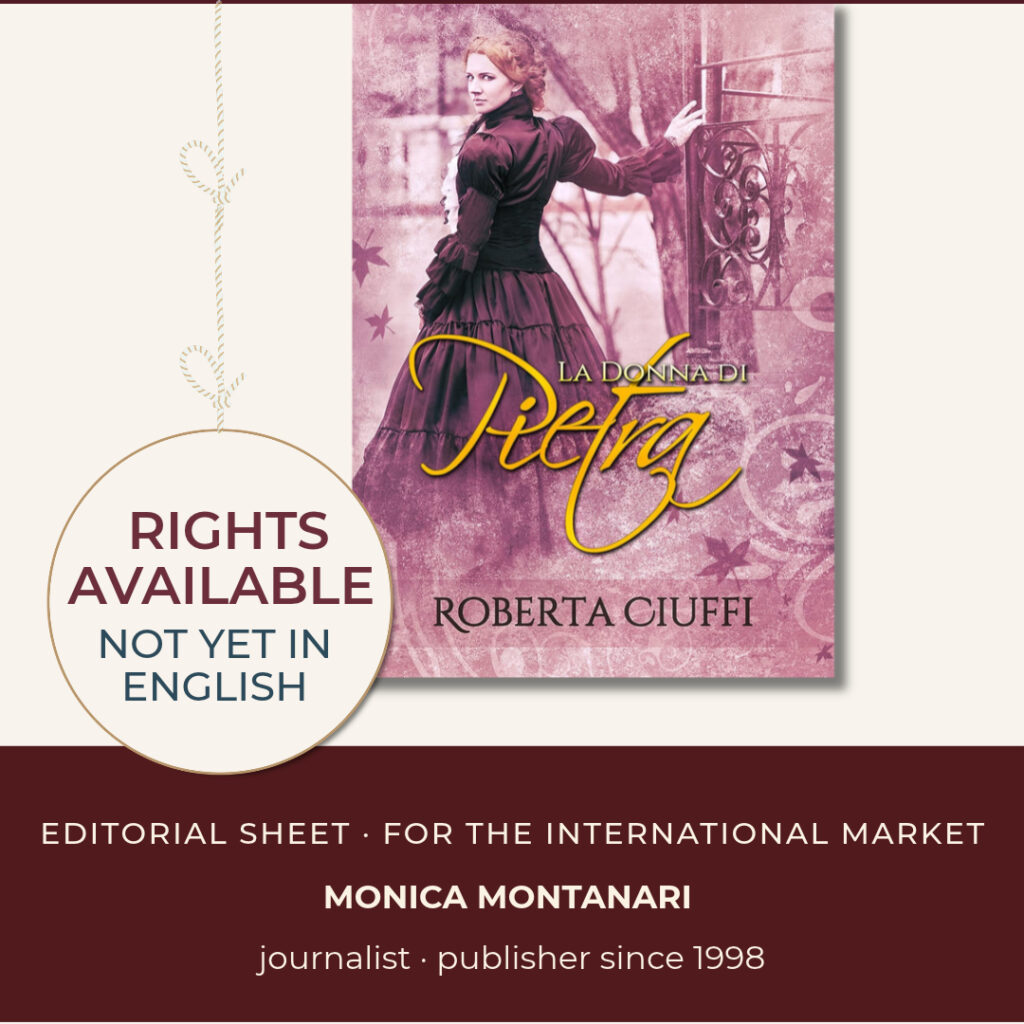
Late nineteenth-century Tuscany: the social microcosm of a small town comes alive, its relationships seemingly informal but in fact hierarchical and based on force. With the vividness of a film, we watch Adelia Corsini move, unmarried and dark within and without. Beside her is Dr. Guerra, her old suitor, a man beaten by life. Fate brings them together again nine years after social scheming and misunderstandings led the young doctor to marry her sister. That disastrous marriage ended with the young wife’s death, and with his professional ruin Dr. Diego Guerra comes back to Adelia to ask for help with his still-small children.
A ray of light begins to filter into Adelia’s darkness, despite her determination to shut herself away in it. That crack of light will kindle new fires in a heart put out by too much pain.
Ideal reader and market fit
Somewhere between Adriana Trigiani’s The Shoemaker’s Wife and Elena Ferrante’s My Brilliant Friend, Ciuffi’s La donna di pietra stands out for its typically closed Tuscan microcosm, the stately house of a small town, and for the universal dynamics of love, where resentment and pride dictate the rules of the heart. It stages the drama of an emotional reckoning and a proud, silent, implacable femininity: a period melodrama for readers who look for visceral passions.
The novel speaks to a female readership strongly attached to historical melodrama and the sentimental family saga. It is particularly suited to readers of Hispanic and Italian-American background (especially southern roots), historically receptive to stories ruled by codes of honor, intense domestic dynamics, family secrets and passive-aggressive conflict. It sits squarely in the “pure” emotional romance segment, in high-angst historical romance, where raw emotion and pathos reign and the heart of the story is the catharsis of an emotional reckoning.
It is not for readers of romantic comedy or smart, witty romance, who are drawn to sharp dialogue and ironically critical takes on the universals of social dynamics.
Craft
- The nineteenth-century Italian family setting has been made familiar to international audiences by plenty of TV series about Italian emigrant families. Here the treatment is closer to small-town society in central and northern Italy: an Italy of solitudes. It is the world of Pinocchio, that same Tuscany, where the Blue Fairy, Geppetto and the Puppet himself all end up facing solitude with the frugality and enchantment of nature.
- The characters are masterfully sculpted, through a conscious register in both dialogue and action.
- The narrating voice is dry and therefore eloquent, like the chimes of an old pendulum clock in a house with closed windows.
- The structure unfolds with perfect pacing, and the themes are universal.
- Enjoyable, beautifully written and deep, this five-star story has one limit: the romantic charm of the male hero does not come through. We glimpse Diego’s allure in the flashbacks, but in the man who flounders and seeks refuge we no longer see that magnetism.
Considerations for translation
- The universal themes and the passing nod to professions require no particular adaptation for an international audience. Historical immersion comes through atmosphere and backdrops rather than through events and contexts that demand prior knowledge or imagery.
- The author is the best Italian romance writer. She comes from translating, for Mondadori, the most acclaimed American and English authors of this very genre.
At a glance
- Author: Roberta Ciuffi
- Original title: La donna di pietra
- Genre: Historical romance, high-angst
- Length: 166 pp.
- Original language: Italian
- Rights: Available, not yet in English. Standalone.
- Suited to readers who want pure emotional register: although the whole genre is emotional.
Editorial sheets for the international market
Monica Montanari is a professional journalist (Italian Order of Journalists).
An independent publisher for 30 years and the author of 30+ books.
Raw reading impressions
The doctor who surrendered to fate in Roberta Ciuffi’s La donna di pietra shows us the force of inertia in old-fashioned women.
Enjoyable, beautifully written and deep, this full five-star story has nonetheless one objective flaw and one subjective one, as regards the full satisfaction of my particular conditions as a reader.
The flaw in the story is that he doesn’t come through. Diego’s charm never reaches us. We glimpse it in the flashbacks, but in the man who flounders and seeks refuge we no longer see that magnetism.
The other limit is relative, and it is mine: the Gozzano-style world of faded patina does not lend itself, in me, to the suspension of disbelief. It is a background that reached me from my grandmothers, too full of female pain to serve as the backdrop of a romance dream. But as I said, the limit is mine.
The typical Balogh-style spinster, offended by an old abandonment, is for me, who read about remote British aristocracies, a Marvel hero to whom anything can happen.
She might even strip naked, of her own accord, in a hunting lodge, in front of a stunned and misanthropic duke. The abandoned spinster of this La donna di pietra, by contrast, shut away wandering through perfect rooms so that they would stay perfect, forbidden even to the sun so that flies would not come in with it… immediately brings to my nostrils “the smell of shade” of Miss Felicita’s house in Guido Gozzano, with her eyes “of a crockery blue”. And look at that: here Adelia has eyes of a “porcelain blue”.
That Felicita, that Adelia, are still with me, in the daguerreotypes I have seen hanging in my own house, which smells of shade. I know everything about them. I sensed their charm in the stories of my grandfather, who left at eighteen for the First World War; in those of my grandmother, who married him for the patience with which she had listened to his hunting exploits; in those of my other grandmother, in the house of shade where they prayed for the domineering father who had just died, and the Miss Adelia of the day, not yet tamed, raised her cry of insurrection:
“What are you crying for? Can’t you feel it’s already better?”
For me there is knowledge here, and memory, and horror at these lives enclosed within the boundaries of the vegetable garden. About these young ladies I already know that nothing truly wonderful can ever happen. And so, in the narrative pact, I cannot do my part; I cannot make my contribution as a reader in terms of dream and expectation.
On top of that, I have an absurdly detailed historical and political education on the nineteenth and early twentieth centuries. Italy’s Ottocento and Novecento are living matter for me, not fairy-tale territory. I won’t go into it, because it is tiring for me and boring for you. But know that for me even Gian Burrasca (Vamba’s classic children’s novel), set in that period, is steeped in sadness.
Italian women of the second half of the nineteenth century cannot manage heroic stature in fiction: they are always and only victims.
To give a contemporary woman a heroic role, Collodi had to invent a fairy with turquoise hair. Puccini had to imagine her as an Eastern queen, Turandot. Salgari exiled his heroines to sea, from the Duchess of Eboli disguised as Captain Tempest to Yolanda, the Black Corsair’s daughter. Pirandello’s and Giacosa’s are stories of men. The only woman happy with her ordinary condition to reach us from the nineteenth century is the little teacher with the red pen (from De Amicis’s Cuore), a foretaste of a future, in the drab grey-flannel world of De Amicis’s pathos.
Impressioni nude e crude
Il dottore arreso alla sorte in La donna di pietra di Roberta Ciuffi ci mostra la forza dell’inerzia delle donne all’antica.
Godibile, scritto meravigliosamente e approfondito, questo racconto da cinque stelle piene ha tuttavia un difetto oggettivo e uno soggettivo relativamente alla piena soddisfazione delle mie particolari condizioni di lettore.
Il limite del racconto è che lui non arriva. Non ci arriva il fascino di Diego. Lo intuiamo nei flashback del passato, ma nell’uomo che annaspa e cerca rifugio questo magnetismo non lo vediamo più.
In termini relativi, invece, si tratta di un limite mio: il mondo di patina gozzaniana non si presta in me alla sospensione dell’incredulità. È un background che mi è arrivato dalle mie nonne, troppo pieno di dolore femminile per poterne fare il fondale del sogno romance, ma come ripeto è un limite mio.
La tipica zitella baloghiana, offesa da un antico abbandono, per me che leggo di remote aristocrazie britanniche, è un eroe Marvel cui tutto può succedere.
Potrebbe perfino spogliarsi nuda, di propria iniziativa, in un casino di caccia, davanti a un duca stupefatto e misantropo. La zitella abbandonata di questo La donna di Pietra, invece, chiusa a girare per stanze perfette perché rimanessero tali, vietate anche al sole perché non entrassero con esso anche le mosche… porta alle mie narici subito «l’odore d’ombra» della casa della signorina Felicita di Guido Gozzano, dagli occhi «d’un azzurro di stoviglia». E guardate un po’, qui Adelia ha gli occhi d’un «azzurro porcellana».
Quella Felicita, quell’Adelia sono ancora con me, nei dagherrotipi che ho visto appesi nella mia casa odorosa d’ombra, so tutto di loro, ne ho intuito il fascino nei racconti di mio nonno partito diciottenne per la prima guerra mondiale. In quelli di mia nonna sposatasi per la pazienza con cui aveva ascoltato le di lui prodezze di cacciatore. In quelli dell’altra mia nonna, nella casa d’ombra, dove si pregava per il padre padrone appena scomparso, e la signorina Adelia di turno, non ancora doma, levava il suo grido insurrezionale:
«Cosa piangete? Non sentite che già si sta meglio?»
Per me qui c’è conoscenza e ricordo e orrore per queste vite chiuse entro i confini dell’orto, e di queste signorine so già che nulla di davvero meraviglioso potrà veramente succedere. E dunque nel patto narrativo non posso fare la mia parte, non posso dare il mio contributo di lettore in termini di sogno e aspettativa.
Per giunta sull’Otto-Novecento ho una formazione storica e politica assurdamente capillare. L’Otto e il Novecento italiano sono per me materia viva, non territorio della favola. E non entrerò nel merito perché per me è fatica e per voi noioso. Sappiate però che per me perfino Gian Burrasca, dedicato a quel periodo, è pervaso di tristezza.
Le donne italiane della seconda metà dell’Ottocento nella narrativa non riescono ad avere spessore eroico: sono sempre e solo vittime.
Collodi, per dare un ruolo eroico a una donna coeva, s’è dovuto inventare una fata dai capelli turchini. Puccini ha dovuto immaginarla regina d’Oriente, la Turandot. Salgari ha esiliato per mare le sue eroine, dalla duchessa d’Eboli nei panni di Capitan Tempesta a Iolanda, la figlia del Corsaro Nero. Quelle di Pirandello e di Giacosa sono storie di uomini. L’unica donna felice della propria condizione ordinaria ad arrivarci dall’Ottocento è la maestrina dalla penna rossa, l’avvisaglia di un avvenire, nel mondo in grisaglia del patetismo deamicisiano.