Heartbeat
Lyanne Quay
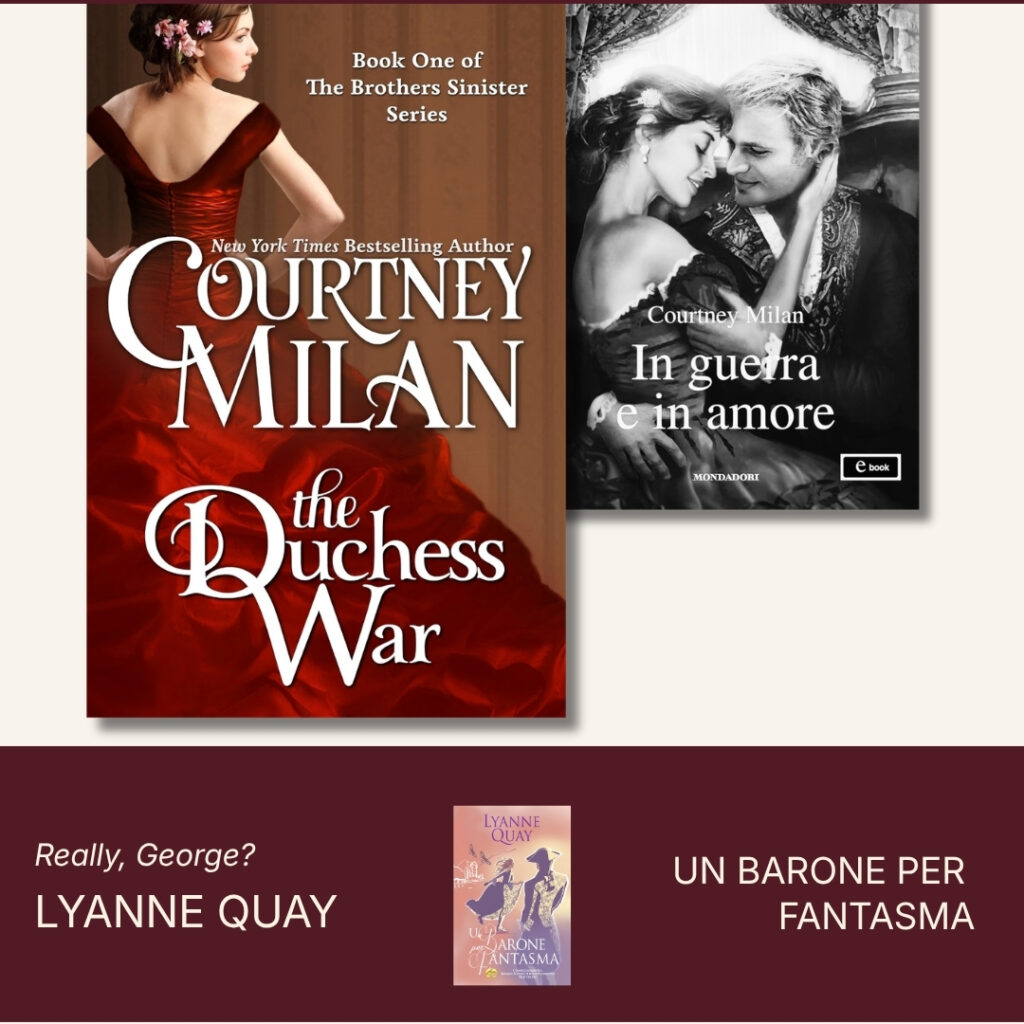
Thanks to a sharp hero with all his teeth, Milan wins The Duchess War.
Intelligent. Well thought. Brisk. Complex, this novel. In short, everything I love in historical romance is in this period comedy by Courtney Milan. Truly fantastic. There is one thing I would improve. I will come to it at the end. First, a taste of how this writing thinks:
‘I think we may have started this conversation the wrong way,’ Robert said at last. Indeed, if the conversation had been a living thing, the merciful act would have been to take it behind the barn and shoot it.
‘Of course you outdo me,’ he told her, brushing her cheek lightly. ‘The human male has a basic fault. The moment we most want to say something intelligent, all the blood leaves the brain.’
‘You don’t expect love.’ She shook her head, confused. ‘That’s the second time you’ve said it. Is this one of those awful novels where you warn me not to fall in love with you, and if I do you’ll turn into Bluebeard and take my head off? You’re handsome. You have all your teeth.’ She looked him in the eye and touched his cheek. He went still. ‘I can’t promise you anything. If you’re good in bed, I might fall in love with you.’ (Grok’s translation of passages from the Italian edition)

A historical romance that moves you and makes you laugh
A historical romance that moves you and makes you laugh. What do you say? Tender, extra-sweet, and it never loses what romance is for: having a good time. Strong themes are not missing. This book hit my own life. Her father is drawn in his contradictions so plainly that I cannot think it is only my father who looks like him. The narrator’s does too. A father who, to save his own skin, betrays the little girl he had already used and played. A hard theme. So a bright style does not pension pain off. It minces it. It dissects it. It does not lie down in it, as melodrama does. Still: do not be confused. This story is soaked in blatant optimism. Everything that can go well, goes well. 🙂
A little trick for dredging up the past lightly
A little trick for dredging up the past lightly. After I finish a book I always ask what could be better, even when it has delighted me like this one.
There is a thing I have found that works, and Balogh — Heath too — do it differently, and better.
As a rule, in historical romance, at least he, if not both of them, has a wound that is supposed to explain who they are now.
Favourite stock: neglectful fathers, wicked mothers, manipulators. The backstory can be well built and original — here it is — but keeping the character’s thoughts sliding back to the old hurt, naming it, naming it again, is sterile. You can nod at it once or twice. You can tell the whole of it, perhaps, in the last confrontation. What does not work is narrating the jump from then to now over and over. To make myself clear, here is a stupid invented example:
I cannot marry you. Nanny hammered my big toe hard before I was thirty.
John banged his head on the wall. He could not marry her… what if she took a hammer to his toe?
John’s gaze left Mary’s blue irises and found the horizon. Even now, at the mere memory, his big toe hurt.
Here you have to do what Balogh does, and Heath, and Reid:
‘I cannot marry you. I am afraid of women
(because nanny hammered my big toe hard before I was thirty — but we do NOT say that).
John banged his head on the wall. He could not marry her… what if she were like all the others?
(meaning: what if she hammered the toe with a smile? Untrusting? But we do NOT say it, we do NOT think it… we let the reader ask, good grief, what happened to this poor man?)
John’s gaze left Mary’s blue irises and found the horizon. He looked for a trace of the old fear, the old pain, but like the setting sun it was only a reddish halo now. Perhaps the ache was only an impression.
(we do NOT say, we do NOT think: even now, if he thought of it, the big toe hurt).’
The whole hammer story should surface in a last scene where he faces someone — nanny herself, perhaps — and only then does the matter of the blow on the toe-joints come out.
Five stars.
Grazie a un eroe arguto e con tutti i denti, la Milan vince sia In Guerra sia In Amore.
Intelligente, ben pensato, brioso… complesso… questo romanzo. Insomma, tutto ciò che adoro nello storico sta in questa period comedy di Courtney Milan, davvero fantastica. C’è un aspetto che migliorerei, ma ve ne parlerò in fondo. Intanto vi do un saggio dell’arguzia di questa scrittura:
— Penso che potremmo aver iniziato questa conversazione nel modo sbagliato — disse infine Robert. In effetti, se la conversazione fosse stata un essere animato, la cosa misericordiosa da fare sarebbe stata portarla dietro il fienile e spararle.
— Certo che mi superate. — Le disse accarezzandole leggermente la guancia. — Il maschio della specie umana ha un difetto di base. Nel momento in cui più desideriamo dire qualcosa di intelligente, tutto il sangue abbandona il nostro cervello.
— Non ti aspetti amore. — Scosse la testa confusa. — Questa è la seconda volta che lo dici. Sarà come uno di quei terribili romanzi in cui mi avverti di non innamorarmi di te, e se lo faccio ti trasformerai in Barbablù e mi staccherai la testa? Sei bello. Hai tutti i denti. — Lo guardò negli occhi e gli toccò leggermente la guancia con la mano. Lui si immobilizzò. — Non posso farti nessuna promessa. Se sei bravo a letto, potrei innamorarmi di te.
Un romance storico che commuove e diverte insieme
Che ne dite? Tenero, stradolce, ma senza perdere il senso delle cose in fatto di romance, ovverosia divertirsi. Non che manchino i temi forti, anzi. In particolare questo libro è entrato in risonanza con la mia biografia: il padre di lei è descritto nella sua contraddittorietà in modo tanto realistico da farmi ritenere che non sia solo mio padre a somigliargli, ma anche quello della narratrice. Abbiamo un padre che, per salvare la buccia, tradisce la bimbetta che aveva circuito e strumentalizzato fino a quel momento. Tema forte. Dunque non è che una scrittura brillante mandi in pensione il dolore: semplicemente lo trita, lo viviseziona, non vi si lascia andare a corpo morto, come avviene invece nella narrazione melodrammatica. Ok, comunque non lasciatevi confondere: questa storia è permeata di ottimismo smaccato, tutto ciò che può andare bene va bene 🙂
Un trucchetto per rivangare il passato in leggerezza
Veniamo alle cose che si potrebbero migliorare. A fine lettura me lo chiedo sempre, anche se il libro mi ha entusiasmato come questo.
Beh, c’è una cosa che ho scoperto che funziona e che la Balogh, ma anche la Heath, fanno in modo diverso e meglio.
Di norma, in tutti i romance storici, almeno lui, se non entrambi i protagonisti, hanno un problema cui ricondurre la spiegazione della loro attuale psicologia.
Gettonatissimi i padri e le madri trascuranti, malvagi, manipolatori… La situazione pregressa può essere anche ben articolata e originale — e in questo caso lo è — tuttavia continuare a far scivolare le riflessioni del personaggio sulla vecchia ferita, citandola e ricitandola, è sterile. Vi può essere l’accenno un paio di volte, la narrazione compiuta del pregresso magari nel confronto finale… ma continuare a narrare il salto da ieri a oggi non funziona. Per farmi capire, ecco come di rigore un esempio di fantasia stupidissimo:
Non ti posso sposare, la tata mi martellò fortemente l’alluce quando non avevo ancora trent’anni.
John batté la testa al muro, non poteva sposarla… e se lei gli avesse preso a martellate l’alluce?
Lo sguardo di John si distolse dalle iridi azzurre di Mary e fissò l’orizzonte. Ancora, al solo ricordo, gli doleva il ditone del piede.
Qui bisogna fare come fa la Balogh e come fa la Heath e anche la Reid:
«Non ti posso sposare, ho paura delle donne
(perché la tata mi martellò fortemente l’alluce quando non avevo ancora trent’anni, ma NON lo diciamo).
John batté la testa al muro, non poteva sposarla… e se lei fosse stata come tutte?
(ovvero gli avesse preso a martellate l’alluce col sorriso sulle labbra? Malfidata? Ma NON lo diciamo, non lo pensiamo… lasciamo che il lettore si chieda “ma caspiterina che gli è capitato a questo, poveretto?”)
Lo sguardo di John si distolse dalle iridi azzurre di Mary e fissò l’orizzonte. Cercava traccia della paura, del dolore d’un tempo, ma come il sole calante era ormai solo un alone rossastro, forse quel malessere era solamente un’impressione.
(NON diciamo, non pensiamo: Ancora, se ci pensava gli doleva il ditone del piede.)»
Tutta la storia delle martellate deve affiorare in una scena finale in cui lui si confronta con qualcuno, magari la tata stessa, e a quel punto emerge la faccenda della percossa sulle falangette.
Cinque stelle.